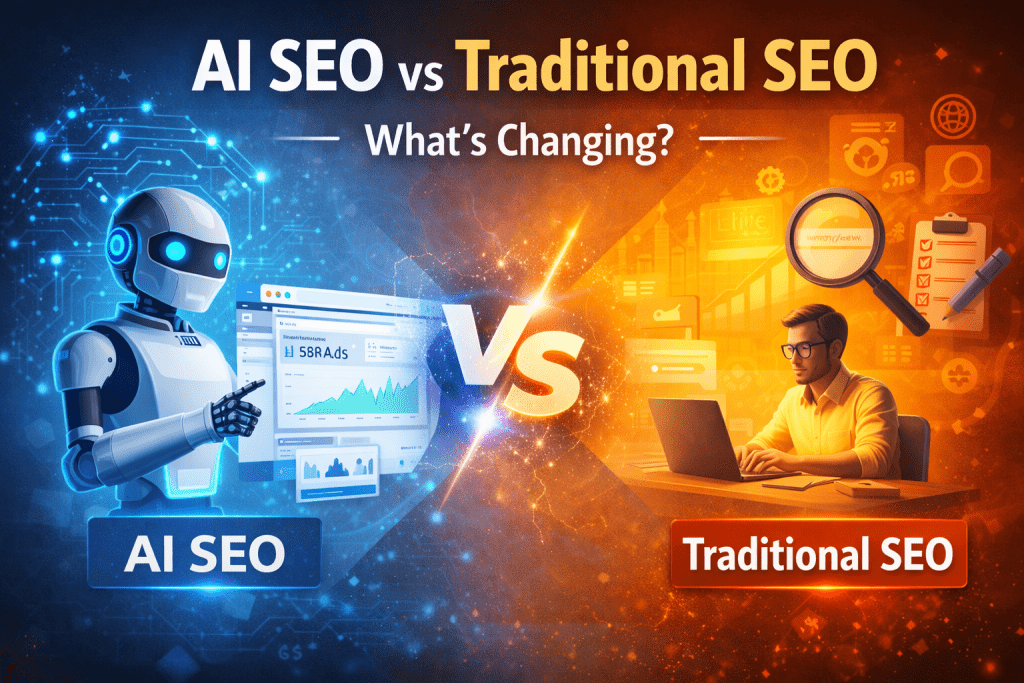
The world of SEO is rapidly evolving, and businesses in 2026 must adapt to stay competitive. Traditional SEO, which focuses on keywords, backlinks, and on-page optimization, has served companies well for years. However, the rise of AI-powered tools and search engine algorithms is reshaping the landscape. Understanding AI SEO vs traditional SEO is critical for marketers, business owners, and website managers who want to maintain or improve their online visibility.
What Is Traditional SEO?
Traditional SEO refers to the set of techniques used to improve a website’s ranking on search engines like Google, Bing, and Yahoo. It involves strategies that have been around for over a decade:
Keyword research: Identifying the terms users search for.
On-page optimization: Optimizing title tags, meta descriptions, headings, and content.
Off-page optimization: Building backlinks and citations.
Technical SEO: Improving site speed, URL structure, mobile responsiveness, and crawlability.
Traditional SEO relies heavily on manual analysis, content planning, and backlink building. While effective, it can be time-consuming and sometimes slow to show results. Businesses often hire SEO agencies, use SEO tools like Ahrefs or SEMrush, or employ SEO specialists to execute these strategies.
How AI Is Transforming SEO
Artificial Intelligence (AI) is changing how search engines rank content and how marketers approach optimization. AI-driven SEO uses machine learning, natural language processing (NLP), and advanced algorithms to improve search visibility.
Key changes include:
1. Smarter Keyword Research
AI SEO tools analyze search intent, not just search volume. This allows marketers to target long-tail, high-intent keywords more effectively. For example:
Instead of just “SEO tools,” AI recommends “best AI SEO tools for eCommerce in 2026”.
Tools like Surfer SEO or Semrush AI can suggest content structure, related topics, and semantic keywords automatically.
2. Content Optimization at Scale
AI can assist in writing, editing, and structuring content that ranks. It uses algorithms to:
Suggest keyword placement
Improve readability
Generate meta tags, headings, and FAQs
Identify missing subtopics in articles
This allows marketers to produce high-quality content faster while maintaining SEO standards.
3. Improved Search Intent Matching
AI understands user intent better than traditional methods. Modern search engines like Google’s Bard, GPT-powered Search, and MUM prioritize content that satisfies the intent behind a query rather than simply matching exact keywords.
Businesses focusing on AI SEO strategies can rank higher by creating solution-oriented content, answering questions, and providing value beyond keyword stuffing.
4. Automated Technical SEO
AI tools can automatically identify technical issues on your website, including:
Broken links
Slow-loading pages
Crawl errors
Mobile responsiveness issues
Traditional SEO required manual audits, but AI tools can scan your website continuously and suggest fixes in real-time, saving time and improving efficiency.
Key Differences Between AI SEO and Traditional SEO
| Aspect | Traditional SEO | AI SEO |
|---|---|---|
| Keyword Research | Manual, based on search volume | Automated, based on search intent |
| Content Creation | Manual writing and optimization | AI-assisted content generation and optimization |
| Technical Audits | Periodic, manual checks | Continuous AI-driven monitoring |
| Search Engine Understanding | Focused on exact matches | Focused on intent, semantics, and context |
| Speed | Slower to implement and see results | Faster, scalable, and adaptive |
| Backlink Strategy | Manual outreach | AI can suggest relevant backlinks and analyze competitor link profiles |
Why Businesses Should Integrate AI SEO
Integrating AI SEO alongside traditional SEO strategies provides significant advantages:
Faster content production without sacrificing quality
Better targeting of high-intent, long-tail keywords
Continuous technical optimization with real-time alerts
Enhanced understanding of user behavior through AI analytics
Improved ROI as AI tools automate repetitive tasks
For example, eCommerce websites on platforms like Shopify, WooCommerce, or WordPress can use AI SEO tools to optimize product descriptions, improve category pages, and generate FAQs automatically. This makes it easier to rank locally or globally and capture high-intent traffic.
Challenges of AI SEO
While AI offers many advantages, it’s not a complete replacement for human SEO expertise. Some challenges include:
Risk of generic or low-quality content if AI is not guided properly
Over-reliance on AI tools without understanding search intent
Need for human review to maintain brand voice and accuracy
High costs for advanced AI SEO software subscriptions
Businesses should adopt a hybrid strategy, combining traditional SEO knowledge with AI-powered tools for maximum impact.
Tools Revolutionizing AI SEO
Here are some AI tools transforming SEO in 2026:
Surfer SEO – AI-driven content planning and optimization
Clearscope – Semantic content analysis for keyword optimization
ChatGPT / GPT-4 – Content generation and FAQs creation
SEMrush AI – SEO audits, keyword research, and competition analysis
Frase AI – Content briefs, topic suggestions, and question targeting
Integrating these tools into your workflow allows businesses to rank faster, optimize better, and stay ahead of competitors.
FAQs: AI SEO vs Traditional SEO
Q1: Can AI replace traditional SEO?
A: Not completely. AI enhances traditional SEO processes but human oversight is essential for strategy, quality control, and creativity.
Q2: Is AI SEO suitable for small businesses?
A: Yes. AI tools can help small businesses compete with larger competitors by automating research, content creation, and technical SEO.
Q3: How do AI and traditional SEO complement each other?
A: Traditional SEO provides the foundational knowledge and strategy, while AI automates repetitive tasks, provides insights, and optimizes content efficiently.
Q4: Will AI SEO improve Google rankings?
A: Yes, when combined with a strong content strategy and proper optimization, AI SEO improves relevance, content depth, and search intent matching, boosting rankings.
Q5: Which platforms benefit most from AI SEO?
A: eCommerce sites (Shopify, WooCommerce), WordPress blogs, corporate websites, and news portals benefit the most from AI-assisted SEO strategies.
Conclusion: The Future of SEO Is Hybrid
The future of SEO lies in a hybrid approach. Businesses that rely solely on traditional SEO may fall behind, while those who fully embrace AI without strategy risk generic content. By combining AI SEO tools with human expertise, marketers can:
Produce high-quality, intent-driven content
Optimize technical SEO automatically
Analyze competitors and adapt quickly
Focus on strategy and creativity rather than repetitive tasks
Adopting AI SEO is no longer optional — it’s a necessity for businesses that want to stay competitive, rank higher, and drive real results in 2026 and beyond.